Webinar: Mastercard on How Open Finance Fuels Banking Growth
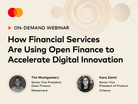
Open finance is transitioning from an emerging concept to a foundational layer of digital banking – a fact emphasised in a recent webinar called How Financial Services Are Using Open Finance to Accelerate Digital Innovation.
Hosted by BizClik in collaboration with Mastercard and Citizens, the session explored how financial institutions are operationalising open finance to drive revenue growth, improve customer experiences and unlock new innovation pathways.
- Ella Wilkinson, Director of BizClik Studio (host)
- Tim Montgomery, Senior Vice President of Open Finance at Mastercard
- Kara Zanni, Senior Vice President of Product at Citizens Bank
Open finance moves to centre stage
Opening the webinar, Ella emphasised the structural shift underway across financial services – a shift backed by data.
According to Mastercard and FT Longitude’s State of Open Finance 2026 report, 75% of executives report a direct revenue uplift from open finance initiatives.
For Tim, this evolution is driven by changing consumer expectations.
“Consumers now have more choice than ever,” he says. “They have higher expectations, and, quite honestly, they have far less tolerance for a fragmented financial services experience.”
Crucially, for Tim, openness alone is not enough and control is key.
He emphasises that 75% of consumers said they would actually switch financial services providers for greater transparency over how their data is being used, signalling a shift toward what he describes as “agency for consumers”.
From data access to value creation
While adoption is accelerating, the webinar made clear that the real opportunity lies in how firms translate access to permissioned data into tangible customer value.
Tim suggests a starting point: “It really starts with reducing friction – enabling faster onboarding, simplifying payments, enabling seamless account connectivity.”
However, he adds that the longer-term advantage lies in relevance.
“The bigger opportunity comes from turning this permissioned data into relevance for the customer,” he says.
This dynamic creates what he described as a “flywheel effect”. This is where trust enables data sharing, data powers better experiences and those experiences drive engagement and revenue.
That’s not to say that gaps have been eradicated, however.
Tim says that poor consent capture alone is costing firms financially.
“The executives we surveyed estimate they’ve lost an average of 4.6% in annual revenue by not effectively capturing appropriate customer permissions,” he continues.
This emphasises that consent is more than just compliance, but a commercial lever.
Trust, infrastructure and APIs
During the webinar, rust emerged as a central theme – underpinned by technology infrastructure.
Tim highlights that “high-quality API infrastructure is really what makes open finance work at scale,” with 47% of executives prioritising improvements in data standards and API reliability.
Performance and consistency are critical.
“It has to work, it has to be performant and consumers have to trust it,” he says, warning that poor infrastructure leads to “inconsistent experiences” that erode trust.
The importance of data quality is set to intensify as AI adoption grows.
Tim adds: “As AI prevails, it can only deliver on that value if the underlying data is trusted and continually accessible.”
Use cases delivering immediate ROI
From onboarding to lending, several high-impact use cases are already demonstrating measurable value.
One of which is account-to-account payments, which Tim says have reached 71% adoption among executives, alongside lending and credit decisioning powered by real-time data.
A practical example is income verification in mortgage applications, where customers can link accounts instead of submitting documents – saving time and reducing friction.
At Citizens, these principles are being applied directly to customer journeys.
Kara shares how the bank is embedding open finance into onboarding and switching experiences.
“We’re using open finance as a tool to help reduce friction at the most critical moments in a customer’s banking journey,” she says.
Citizens has focused on two core use cases: Direct Deposit Switch and Payment Switch.
These solutions address a key barrier in banking – moving financial activity between providers.
“When people decide to switch banks, the hard part isn’t opening the account – it’s everything that comes after,” Kara explains.
By digitising and automating these processes, the bank has driven measurable outcomes.
She adds: “We’ve also seen an increase of about 20% in deeper engagement from customers using these features
“It's not data for data’s sake – it’s using that permissioned connectivity to make hard tasks simpler.”
AI and automation
Looking ahead, both speakers highlight the convergence of open finance and AI as a key driver of future innovation.
Kara expects “a lot of innovation over the next couple of years around the integration of agentic AI to help customers automate tasks and manage their finances with almost no effort”, with Tim pointing to hyper-personalisation and real-time financial services as the next phase.
Open finance, he argues, provides the trusted data layer required to power these capabilities.
For organisations earlier in their journey, the message is clear: focus on outcomes, not technology.
“The most important place to start is not with the technology – it’s with the customer problem you're trying to solve,” Kara advises.
Tim adds: “You have to start with the customer.”