Fifth Third Bank CSO on Doing Well by Doing Good

Fifth Third Bank’s sustainability agenda is rooted in a simple idea: do well by doing good.
Chief Sustainability Officer Pratik Raval says the super-regional lender, with $215bn in assets and a Midwest–Southeast retail footprint, sees growth where communities thrive. Speaking at Sustainability LIVE: Climate Week NYC, Raval outlines how the bank backs the economy of the future through practical finance for energy affordability, access and resilience.
That means distributed generation and storage for businesses and households, innovative approaches to rising insurance costs and products that improve long-term payback on efficiency.
It also means place-based economic development that concentrates the bank’s full toolkit in specific neighbourhoods. The focus spans five pillars: affordable housing solutions, small business lending, energy and infrastructure, workforce development and access to finance.
With a US$100bn sustainable finance goal by 2030 and $45bn already delivered, Fifth Third aims to turn societal need into scalable, risk-aware, tangible opportunity.
Pratik, could you please introduce yourself and summarise your role at Fifth Third Bank?
I'm Chief Sustainability Officer at Fifth Third Bank, which, as you may know, is what we call a super-regional bank. We are about US$215bn in asset size.
Our consumer banking footprint is Midwest and Southeast primarily. And our commercial clients are all across the US.
Fun fact – we just celebrated a special birthday.
Fifth Third as a fraction in decimal points is 1.667. We have been in business for 166.7 years, so it was a big, big, big year this year. And we are excited and thankful to the communities and customers for keeping us in their hearts and minds.

How very banking to come up with a number like that. How would you describe Fifth Third's approach to sustainability?
We always say we want to do well by doing good. The word sustainability has evolved over time, but fundamentally for us it is about operating with ethics and good governance, doing good by the customers and communities and employees, and then supporting the economy of the future.
So focusing on the current, but also being ready for the future, whether it is sustainable transition, resiliency, finance. How do we not only focus and continue to help our customers innovate, do a great service, but also help them thrive in what is to come? Our approach to sustainability is much broader, but fundamentally it is what you would call good business.
How difficult do you find it is to convince people that banking and sustainability can be allies?
We thrive when our communities thrive, right? So fundamentally, philosophically, we are all aligned on the broader definition of sustainability.
Now, when it comes to operationalisation, some of the strategy, then it becomes a prioritisation exercise – what is the need of the customers and communities? What is the regulatory environment and where is the opportunity?
We are definitely supporting the sustainable economy, the sustainable transition and the economy of the future. We are supporting our clients on their renewables, transition finance and resiliency finance. We are also focused on what we call place-based economics, with a focus on solving the affordability issue and access to finance.
So we are aligned in terms of execution, prioritisation and strategically. We have realised a lot of business opportunities from helping the clients and communities thrive through these different phases of their life and business.
What role does Fifth Third Bank play in expanding energy affordability, access and resilience? Do you have any examples?
Sustainability merges well with business when we really understand the drivers for the needs and what may be the opportunity, specifically when it comes to providing financial capital.
Affordability in the energy space, affordability in general, is becoming a big issue, whether it is housing, whether it is the energy itself, even water.
So resource affordability is becoming a big issue. And the way we think about solving it is by building tools and products and business awareness around what is not only risk reward, but also what is the payback or the ROI for making certain investments.
Whether you are a residential customer or a small business, or a large business, we believe that, because the cost of energy or energy inflation has been increasing exponentially, finding solutions which are more local, which are more mid to long term, and which do not come with a lot of operational costs, are really good solutions.
The other piece where we believe there is going to be a significant need is the availability of energy itself.
We all know that the growth of the US economy, driven by recent advances in AI, is going to come with a lot of energy demand, and if you look at the energy grid of the US, it is severely under capacity.
So how do we support our clients in what is called distributed energy generation and storage, so that it not only provides affordable energy for the long term, but also provides continuous access to the energy?
And then the last piece I would add is the ever increasing cost of insurance. Again, it goes back to affordability, but it all adds up.
So we are looking at innovative ways for financing or mitigating the increasing cost of insurance.
For businesses, there may be challenges around supply chain continuity: for single family homeowners, it may be around the cost of insurance itself or even the availability of insurance in certain markets.
So we are looking at financing products as well as building products, but also we are looking at how we can participate in activities to build the market for us to introduce these products.
And not one company bank asset manager can do it. It is something that we need to come together and solve, so that we can have an end-to-end solution across the entire value chain.
What proportion of the bank's finances would you describe as sustainable finance?
The definition of sustainable finance itself is evolving for us.
The way we define sustainable finance is really lending that helps our customers, from a residential or a single-family to middle market to large businesses – any lending or investment that helps them solve their societal needs, as well as finance that helps them build energy affordability or sustainable energy sources.
So for us, the definition of sustainable finance includes a lot of social finance, affordable housing, access to finance, small business lending and access to our workforce development.
All of that is part of our definition of sustainable finance as well as financing of renewable energy, circularity, sustainable bonds or sustainable capital instruments.
Currently we have a goal of US$100bn of sustainable finance that we want to provide to our customers by 2030.
At the end of last year, we already provided about US$45bn in sustainable finance. So it is a fairly ambitious goal for the size of our bank, but we definitely are making good progress.
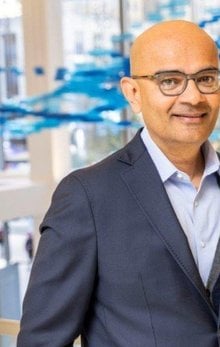
- Pratik Raval
- Chief Sustainability Officer
- Fifth Third Bank
- Cincinnati, Ohio, US
- Alongside being the Chief Sustainability Officer at Fifth Third Bank and a member of the bank's management committee, Pratik is a thought leader, lecturer and speaker. He is responsible for the bank’s corporate sustainability strategy, including US$100bn in impact finance, and energy and resiliency-focused community banking solutions.
What is Fifth Third Bank doing to lead in place-based economic development?
We are a super-regional bank, so we are really embedded in communities. That's how we thrive, that's who we provide solutions to. And over the years, we have realised that, while the challenges of the communities are generally similar across the country, the need for solutions and how those can be deployed must consider the regionality, the locality, the demographic mix, economic growth or projection and workforce readiness.
About four or five years ago, we piloted the Neighbourhood Programme, where we decided that, rather than stretching ourselves thin, we will bring the full force of all the solutions of the bank and start deploying them at community levels.
And eventually, we ended up calling it place-based economic development. But the idea is to identify the local needs of the communities and bring the solutions – financial capital, social capital, political capital – with the mindset of creating economic growth for those communities.
So it is more of a deployment mechanism to solve the local needs and the challenges, and provide solutions which are specific to the needs of the communities.
The five pillars of our place-based solution toolkit are: affordable housing solutions; small business lending; energy and infrastructure solutions; workforce development solutions; and access to finance.
These are the five big tools in our toolkits that we bring from the bank to solve the needs of different communities.
Company portals
Executives
Pratik Raval
Chief Sustainability Officer