
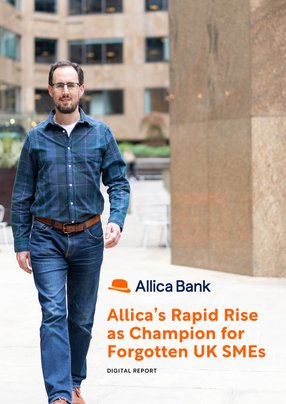
In the shadow of consumer-focused fintechs and corporate banking giants, a significant segment of the UK economy has been quietly underserved.
Richard Davies, CEO of Allica Bank, is on a mission to change that by creating a financial institution specifically designed for established small and medium-sized enterprises (SMEs).
Since obtaining its banking licence in late 2019 and making its first loan just as COVID-19 hit in March 2020, Allica Bank has experienced rapid growth.
This success has been recognised through multiple industry accolades, Allica Bank’s CEO explains.
“We are the fastest growing company over the last four years in the UK,” Richard notes. “We won the Deloitte UK Fast 50 in both 2023 and 2024 and the Sunday Times 100 announced us in the top position in June last year.”
This remarkable trajectory is even more impressive considering the challenging economic environment during the bank's formative years.
While many businesses were struggling to survive during the pandemic, Allica was laying the foundation for what would become one of the UK's fastest-growing financial institutions.
Richard, who took the helm as CEO during 2020, brings a unique blend of experience that has proven invaluable for Allica's mission.
His career spans both traditional banking giants and disruptive fintechs – a combination that has informed Allica's approach to serving established SMEs.
“My career has got quite different parts to it,” Richard explains. “I was at Barclays and HSBC, which are clearly very large traditional banks, and OakNorth and Revolut – two leading UK fintech unicorns.”
It was at Barclays where Richard first developed his understanding of SME banking needs. “I'm always grateful to Barclays for taking a risk on me. Back in 2007, I was pretty young and had a background in strategy consulting and they gave me the southeast region for SMEs to run.”
This early exposure provided crucial insights that would later shape Allica's approach. “I learned a tonne of stuff from that—what the clients were like, what they needed from their banking products – but also, from the HSBC and Barclays side, I saw firsthand the problems they had in serving these types of businesses.”
His subsequent roles at fintech disruptors added another dimension to his expertise. “From the fintech side, Revolut in particular is absolutely world-class at product and engineering.
“So, there were a lot of takeaways from that in terms of how a truly digital-native company goes about building technology for customers.”
This fusion of experiences has been central to Allica's proposition. “I'm pretty certain we'd have little of our current success without that fusion of experiences – and not just myself.
“Some of my key team have a combination of experience in a major bank and experience in a tech-driven company and I think that combination of skills is rare but very powerful.”
Meeting the unique needs of established businesses
The bank's target market – businesses with approximately five to 250 employees – represents roughly one-third of the UK economy. Despite their economic significance, these established businesses have found themselves in a neglected middle ground.
“Consumer and micro-businesses have moved to an app-driven model,” Richard says. “But if you're running a 50-person company, alongside a great app, you typically want a human to talk to who can deal with complexity and provide support and advice.”
This insight forms the foundation of Allica's strategy: combining human expertise with cutting-edge technology.
Rather than eliminating the human element to reduce costs, as many traditional banks have done, Allica has invested heavily in automating everything that sits behind that human interaction.
“One of the things I observed in the major banks was they were going about the cost-to-serve problem in the wrong way,” Richard reveals.
“They were generally removing the human the client talked to because they couldn't change their legacy back office. But the human is the main thing the client valued.”
Richard sees this as a fundamental misalignment with customer needs. “So as we thought about this problem, we've said, ‘look, while providing great value, how do we maintain the human that can talk to the client while automating as much as possible via proprietary software, essentially everything that sits behind that human?’”
This approach allows Allica to deliver the personalised service SMEs value while maintaining competitive operational efficiency.
For a segment often caught between the highly automated, self-service model of consumer banking and the high-touch relationship banking of corporate finance, this hybrid approach addresses a critical gap in the market.
Building a tech engine for SME growth
With over 200 in-house engineers, Allica has made significant investments in proprietary technology.
The bank's approach to development is distinctly decentralised, with 21 different engineering squads each responsible for continuously improving a particular service or product.
“We have a very strong philosophy that even our most mature product is less than half done,” Richard explains.
“We think we can improve every product dramatically, so we have engineering squads attached to every service and their job is to keep delivering new value to customers.”
This continuous improvement methodology reflects Allica's DNA as a technology-driven bank. Rather than periodic major releases, the focus is on continuous incremental enhancements that compound over time.
Each ‘squad’ owns a dedicated thread of development and is empowered to make decisions that benefit customers.
“It's about decentralised progress as opposed to me saying, ‘let's do these three things’,” Richard notes. “But the output of all that work should be that we achieved our company goals.”
This tech-first approach has enabled Allica to build a comprehensive suite of financial services for SMEs in record time.
“From our initial secured-term lending product, we've built out both lots more lending products but also current accounts and cards and various savings accounts. And we're increasingly pushing into adjacent financial operations categories like expense management or credit control,” Richard says.
The bank's financial offerings fall into two main categories. First is lending, which is focused on supporting business growth through financing new equipment, properties, or working capital needs.
The second is payments and savings, where Allica aims to provide dramatically better value than traditional banks.
The value gap in SME banking
Richard is particularly passionate about addressing what he sees as a significant value gap in SME banking services.
Traditional banks, he argues, have been extracting excessive fees from established businesses while providing subpar service and interest rates.
“Established SMEs are getting gouged by the major banks,” Richard continues.
“They're being charged monthly account fees, payment fees, card fees and typically receiving very low interest on savings accounts. We estimate there's about £9bn (US$11.6bn) per year that these businesses are missing out on.”
In contrast, Allica's business account – deliberately branded as the "Business Rewards Account" – for its target customer profile features no account fees, no payment fees, highly competitive interest rates and cashback on card spending.
This value-based approach has helped drive Allica's rapid growth in the market.
Productive lending for economic growth
For Richard, a critical focus area is what he terms "productive lending" – financing that helps businesses invest, grow and become more productive, rather than simply recycling existing assets.
“There's been a substantial drop-off in productive business lending over the last 15 years,” Richard says. “There's a lot of lending that recycles existing assets, typically property, but not enough going into helping businesses grow and become more productive.”
He sees this as a fundamental issue affecting the UK's economic performance and believes Allica has a role to play in addressing it.
The bank actively measures whether the businesses it serves are growing faster than the overall economy average.
“Our purpose is helping support businesses and helping businesses to grow,” Richard explains. “We actually check: are businesses that Allica works with growing faster than the overall economy average? And pleasingly, that's yes, and by quite a decent distance.”
This focus on stimulating real economic growth through productive lending differentiates Allica from many mainstream lenders who predominantly focus on residential mortgages – which Richard describes as "ultimately an unproductive asset" when financing existing rather than new housing.
“By financing a house that's not a new house being built, you're just pushing up house prices through more and more competition around house price financing,” Richard explains.
Technology driving client relationships
Allica's technology strategy goes beyond building efficient internal systems. It is fundamentally about enhancing client relationships and improving the customer experience across all touchpoints.
The bank maintains a hyper-focus on its chosen market segment. “We are very religious about the segment,” Richard explains.
“We focus on an established SMEs – not consumer, never corporate. That really helps you to constantly think about what that segment needs and build products and services that work for it.”
This laser focus has enabled Allica to build a reputation for understanding the unique needs of established businesses.
While the bank does offer self-service options via its app, it recognises that many clients in this segment still want the ability to speak with a knowledgeable human when needed.
“We think for this segment people still want a human to talk to," Richard says. "Our view is very much about how do you provide self-serve options for clients that want it but also provide a human, and then, to be able to afford it, how do you automate everything that sits behind that human?"
In addition to serving SMEs directly, Allica works with key intermediaries in the ecosystem. “In lending, we tend to work a lot with some of the professionals out there, like the commercial finance brokers.
“Their entire day-to-day job is that they may have 50, 100, 200 SMEs they work with and are helping them find finance. So we build tools specifically for those brokers and similarly for accountants.”
The future of business banking
Looking ahead, Richard has ambitious plans for Allica Bank. “Our key aim by 2027 is to achieve 10% penetration of this established business segment in the UK,” he says.
“We're about 3-4% right now, so it would be significant growth, but we think that's quite possible with the trajectory we've built over the last few years.”
To reach this goal, the bank is focusing on three key trends in SME financing. First is the aforementioned emphasis on productive lending.
Second is the integration of financial operations like spend management, accounts receivable and cashflow management directly into the bank account experience.
“For our segment – maybe not for mid-market and enterprise, but for our segment – these services should be directly attached to the bank account. We don't think there's a scaled future for standalone services in that space.”
The third area is artificial intelligence (AI), particularly generative AI, though Richard approaches this with pragmatic caution.
For Allica, the application of large language models to banking for established SMEs presents unique challenges.
“Banking is a high-stakes environment where you need really high accuracy, and models are typically best suited to high volume situations. Established SMEs are a fairly complex segment with much lower volume than consumers,” he notes.
“So I think it's going to look quite different to a sort of mass volume consumer non-banking application.”
Nevertheless, Richard is convinced that these technologies will drive significant change in how Allica serves its customers.
“I'm pretty convinced that there will be very significant change driven by the application of large language models to what we do.
“But I think it's harder than the high volume non-banking space, so we're just trying to be experimental and thoughtful about how we approach it.”
Measuring success by recommendation
For all its technology investments and growth ambitions, Allica maintains a straightforward measure of success: client recommendations.
“Our overall North Star metric is being recommended by clients because we think that's the highest possible bar,” Richard reveals.
“To recommend you, someone has to love what you do to the degree they're prepared to put their own name behind it. It's also the best form of growth – it's free, unpaid growth.”
This focus on earning genuine enthusiasm from clients reflects Allica's broader purpose.
While the bank is commercially successful – having raised over £350m (US$451.2m) in capital from investors including TCV, Atalaya, and Warwick – Richard emphasises that success is ultimately about making a difference for an underserved but economically vital segment.
“I have a huge sense of purpose around trying to do something for this segment that makes up about a third of the economy but still seems to be forgotten about,” Richard shares.
“The more you can attach the work you do to a sense of it being meaningful to the world, the easier it is to enjoy it.”
Explore the latest edition of FinTech Magazine and be part of the conversation at our global conference series, FinTech LIVE.
Discover all our upcoming events and secure your tickets today.
FinTech Magazine is a BizClik brand