
Trump Tariffs Trigger Currency Shock as Dollar Falls
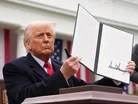
Global markets reacted with pronounced volatility today as investors processed the implications of the Trump administration's new tariff regime.
US equities opened more than 3% lower while the dollar fell 1% against a basket of currencies, reflecting concern that protectionist measures could harm domestic economic prospects and trigger international retaliation.
A New Tariff Landscape
The Trump administration has implemented comprehensive tariff measures that exceed those from his first term in both magnitude and scope.
Starting 5 April, a 10% baseline tariff will apply to all imports, with additional levies targeting China (54%), the European Union (20%), Japan (24%) and the UK (10%).
George Vessey, Lead FX & Macro Strategist at Convera, notes: “This is a major shock to the world economy and approaches the worst-case scenario Trump had outlined during his campaign.”
The new tariffs will raise the average US import duty rate to 23%, up from 2.3% in 2024.
This represents the highest tariff level in more than a century, surpassing the Smoot-Hawley tariffs of 1930 that economists associate with deepening the Great Depression.
The immediate market response saw Nasdaq 100 futures drop approximately 4% and S&P 500 futures decline nearly 3%.
In a risk-off movement, gold reached new all-time highs while Treasury yields fell across all maturities, contributing to dollar weakness that pushed the currency to six-month lows.
For fintech companies involved in cross-border payments and currency exchange, the volatility presents operational challenges but potential revenue opportunities as businesses seek cost-effective ways to manage international transactions in an increasingly fragmented trade environment.
European Response Bolsters Euro
The euro gained strength against the dollar, pushing beyond $1.09 to match its highest post-election level, partly in response to European Union plans for economic support measures to counter US tariffs.
"EUR/USD is being supported by the proactive approach of EU leaders to US tariffs. The EU is preparing a package of crisis measures to guard its economy," says George.
Options market data reveals shifting sentiment towards the euro. Risk reversals, an indicator of positioning that compares the cost of bullish versus bearish options, show investors are the most optimistic on the euro's one-month outlook since late 2020.
For European fintech firms, the strengthening euro may affect dollar-denominated costs and international expansion strategies, while potentially providing more favourable conditions for acquisitions of US-based competitors.
While short-term indicators favour the euro, the currency remains vulnerable due to Trump's vocal hostility towards the EU, which may limit trade negotiation flexibility and cloud growth projections.
“Sterling could continue to trade more like a relative haven in this global trade war”
Medium-term support for the euro may come from German fiscal stimulus, which could help Europe weather tariff impacts, while the European Central Bank (ECB) evaluates implications for both growth and inflation before adjusting monetary policy.
Sterling Finds Support
The pound has functioned as a relative safe haven amid tariff uncertainty, with the GBP/USD exchange rate reaching $1.31, its highest level since October 2024.
Despite initial volatility during Trump's announcement, sterling benefited from the UK's comparatively lower 10% tariff rate. This more favourable treatment reflects Britain's balanced trade relationship with the US.
"It is not just sterling strength though, it is US dollar weakness – hence the mixed performance of other GBP crosses whilst the USD is lower across the board.
"This is understandable because ultimately, US consumers and businesses shoulder the higher import costs – and US recession risks have shot up, dragging US yields lower," George explains.
UK fintech companies may find the stronger pound advantageous for US expansion efforts while presenting challenges for dollar-denominated revenue streams.
“Sterling could continue to trade more like a relative haven in this global trade war,” George concludes.
Fintech industry reaction
As of 3 April 2025, fintech firms Tribe Payments and PayFuture have had their say on Trump's newly enforced tariffs:
Robin Anderson, Head of Product Management at Tribe Payments
“Trump’s newly announced ‘Liberation Day’ tariffs, targeting low-cost direct-from-China ecommerce with a 30% tax on all foreign orders under $800, represent a seismic shift for cross-border commerce. Merchants shipping into the US must now factor in longer customs processing times, higher fulfilment costs, and the likely increase in customer service issues related to unexpected duties.
“With cross-border tariffs set to rise, the cost of international goods and services will climb - and merchants are already feeling the pinch. For businesses operating across borders, the increase in duties is not just a logistical headache, but a financial one, threatening already narrow margins and forcing a rethink of their operational strategies. For online sellers, the knock-on effects could include reduced cart conversions, payment disputes, and an uptick in chargebacks as shoppers react to unfamiliar charges or delivery delays.
"In this climate, intelligent payments infrastructure becomes a key competitive edge. Advanced payment routing can help merchants reduce transaction costs and avoid unnecessary fees. Faster settlements improve access to working capital, and enhanced fraud mitigation tools help protect revenue when businesses can least afford losses."
Zaki Farooq, Chief Technology Officer and Co-Founder of PayFuture
“The reintroduction of US tariffs on low-value foreign imports, including a 30% tax on sub-$800 orders and even steeper rates for China and the EU, threatens to reshape the landscape for ecommerce and cross-border trade. For merchants reliant on low-cost international fulfilment, the loss of the de minimis exemption will directly affect margins, logistics, and the customer experience.
"As new tariffs increase the cost of global trade, businesses eyeing international growth – or already trading across borders – face mounting challenges. For retail and eCommerce merchants especially, rising duties are squeezing margins and prompting a rethink of cross-border strategies. With Shein and Temu alone accounting for nearly 600,000 daily US-bound parcels under this scheme, the impact on digital-first retail is massive. Higher prices and longer delivery times may frustrate customers, leading to more refund requests and chargebacks unless expectations are properly managed.
"In this environment, efficient international payments become a key competitive differentiator. Tariffs may be out of your control, but improving approval rates to increase your profitability, settlement delays, and currency conversion fees is not. Businesses can cut costs by optimising their payment providers, using local acquirers, and offering region-specific payment methods and currencies that improve both acceptance rates and customer satisfaction."
Explore the latest edition of FinTech Magazine and be part of the conversation at our global conference series, FinTech LIVE.
Discover all our upcoming events and secure your tickets today.
FinTech Magazine is a BizClik brand